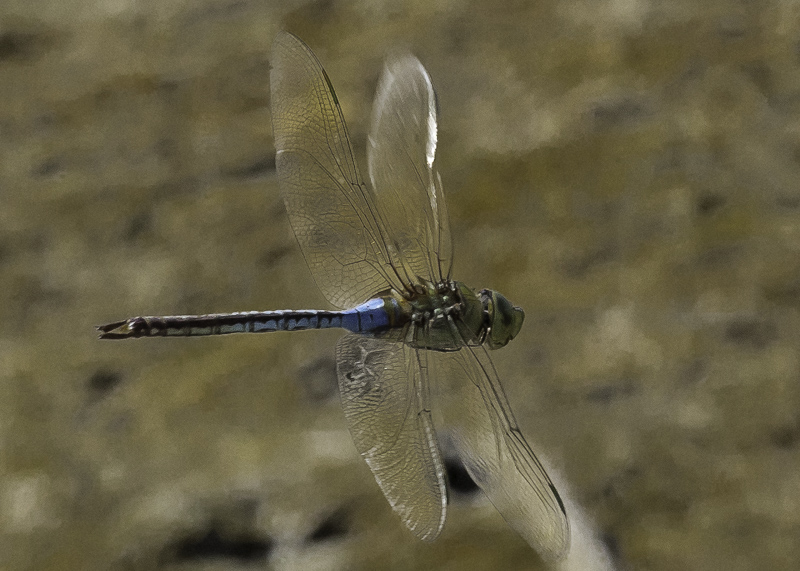
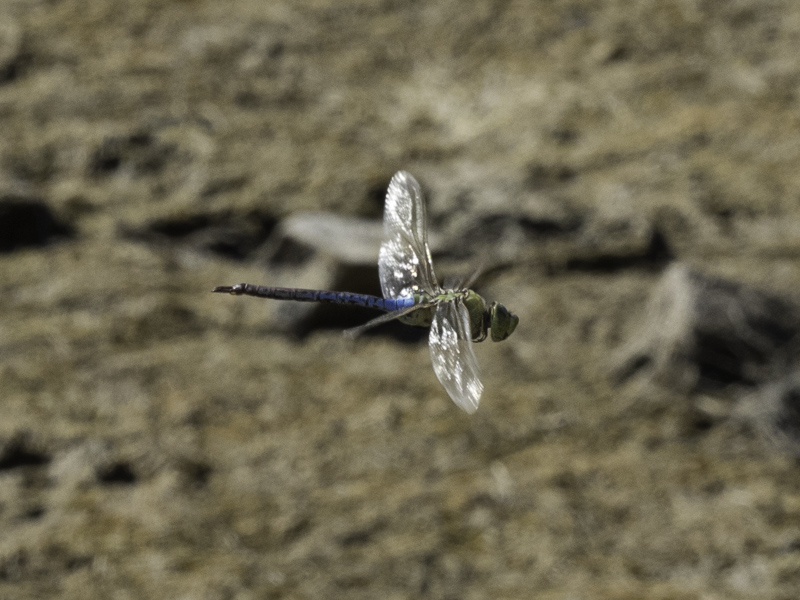
Dragonfly On The Wing
It was a hot afternoon in late September, and I went out to the beach to photograph. There was a small stream emptying into the ocean, and I noticed a large number of dragonflies zooming through the area. After watching for a while, I noticed that there were certain spots where the insects would hover for a short time before moving on. So I sat down on next to the stream and waited for a dragonfly to come.
Chasing flying insects is very difficult. By the time you’ve found one and focused, it’s already flown away. I’ve found that letting them come to you is a much better way to get usable photographs. Dragonflies tend to move in patterns. If you see one hovering in a particular location, it’s very likely that after it leaves, it or another one will soon be back. So I found a location that was near where I’d seen a dragonfly hover repeatedly, sat down, and waited.
I had chosen to use a telephoto zoom in order to stay far enough away that the dragonflies wouldn’t try to avoid me. A long lens is often useful with flying insects because it lets you keep your distance and still get usable images. I used an Olympus Micro Four Thirds mirrorless camera with an Olympus 40-150mm f/2.8 zoom lens and a 1.4x extender. This combination is equivalent to a 112 to 420mm lens on a full-frame camera.
You’d think that for a small flying insect, autofocus would be your friend. Not so. I tried using autofocus, but the dragonfly was relatively small in the frame, even at maximum focal length. When I managed to get a focus spot onto a moving insect, it was almost impossible to keep it there. Although the dragonflies were hovering, they still moved a little, and as soon as the insect moved, the camera refocused on the background. So I switched to manual focus. This worked considerably better. This camera, like many cameras with electronic viewfinders, a focus peaking feature. When using manual focus, the viewfinder shows a white outline around sharp portions of the image, so it's easy to tell when your subject is in focus. In this case, I was able to see the dragonfly outlined in white when it was in focus, and then snap some photos.
Even at a 420mm equivalent focal length, the dragonflies were small in the frame. Coupled with their motion, this gave me images that show the dragonfly, but not as crisply as I'd like. Also, Ithe images would be better with more contrast between the dragonfly and the background. One way to achieve that is with flash. In this setting, the dragonfly was much closer to me than to the background, so flash that would brighten the insect will fall off enough to leave the background almost unchanged. I’ll probably try this again with a longer lens and flash. Both of these bring new technical challenges. A long lens sees a smaller slice of the scene, making it harder to find your subject in the viewfinder. It seems that every time I've gotten the camera aimed, my subject flies away before I can snap the shutter. And if the lens isn’t focused approximately correctly, I can't even see the critter even if it is in the field of view. Practice helps. The more you photograph, the better you’ll get at aiming, focusing, and shooting before it’s too late. If you’re like me, though, you’ll still have a lot of throw-away images. It’s the few good ones that make it worth-while.
<<Photo 20150921-0050>>