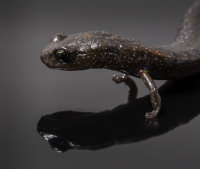
Photographing a Snake
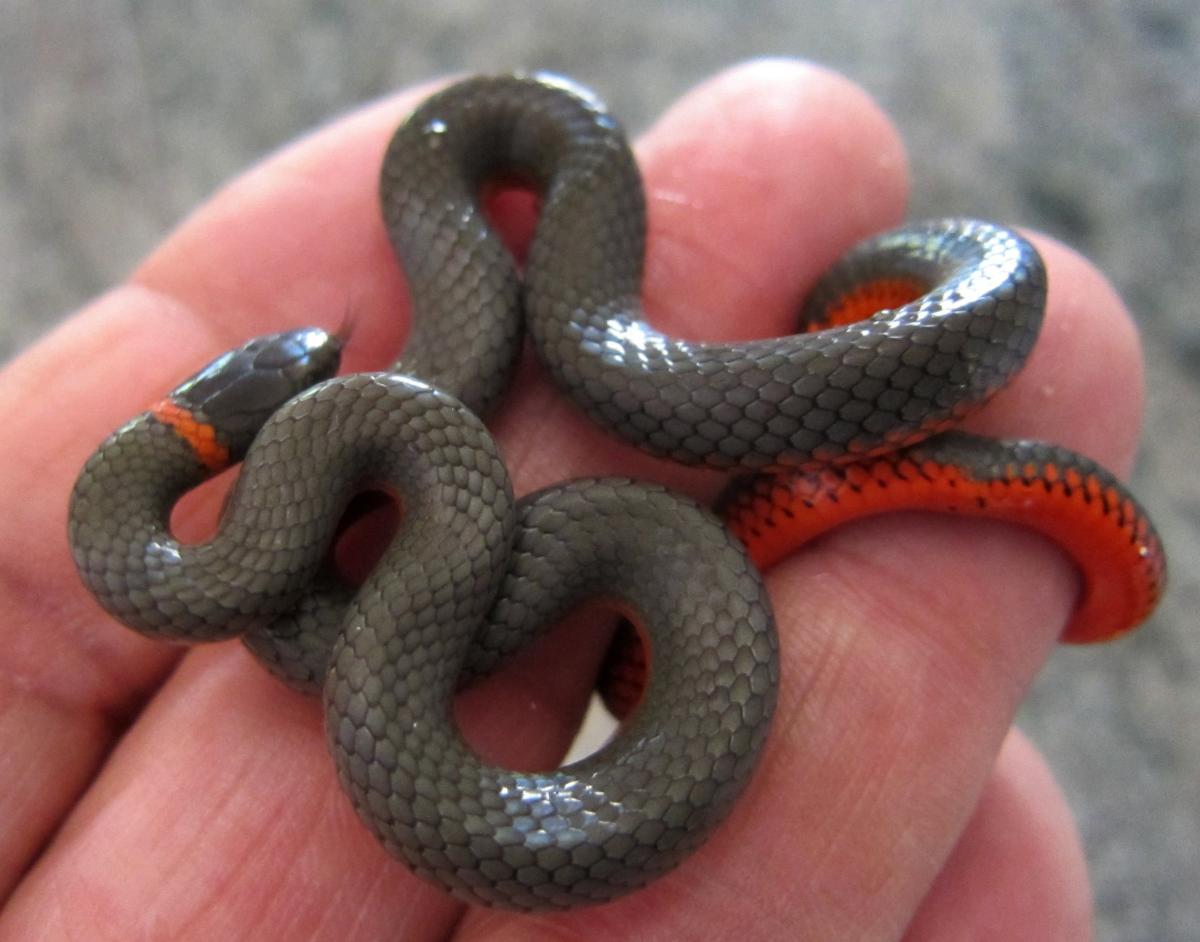
Simon found a ring-necked snake in his yard, and thought it would make a good subject. Ring-necked snakes are common in the U.S. They are small, about the size of an extra-long pencil, and not dangerous. (They are mildly venomous, but their mouths are too small to bite something as big as a human, and they don’t seem inclined to bite in any case.) He took a shot of the snake, holding it in one hand while using the camera with his other. That’s a pretty difficult juggling act. If you look closely, you’ll see the snake’s forked tongue flicking out. This photo was made with a point-and-shoot camera, a Canon PowerShot ELPH 500 HS, in natural shady daylight. This type of light is excellent for small subjects. It’s a very soft light, wrapping around the subject so that every part is illuminated.
Simon put the snake in a container with dirt, bugs, water, and leaves so that it would have a comfortable environment. I brought it home to work with, and decided to start by photographing it in its container. To make these photos, I used a DSLR, a Canon 5D mark ii with a Canon 100mm macro lens and Canon MT-24EXmacro flash. Here’s what the camera setup looked like. This flash works with the camera’s TTL flash control system, which makes exposure pretty simple – it will be good almost automatically. It’s a good idea to check the histogram while you’re shooting to make sure, though. Many subjects will work better with a little plus or minus adjustment of the flash settings.
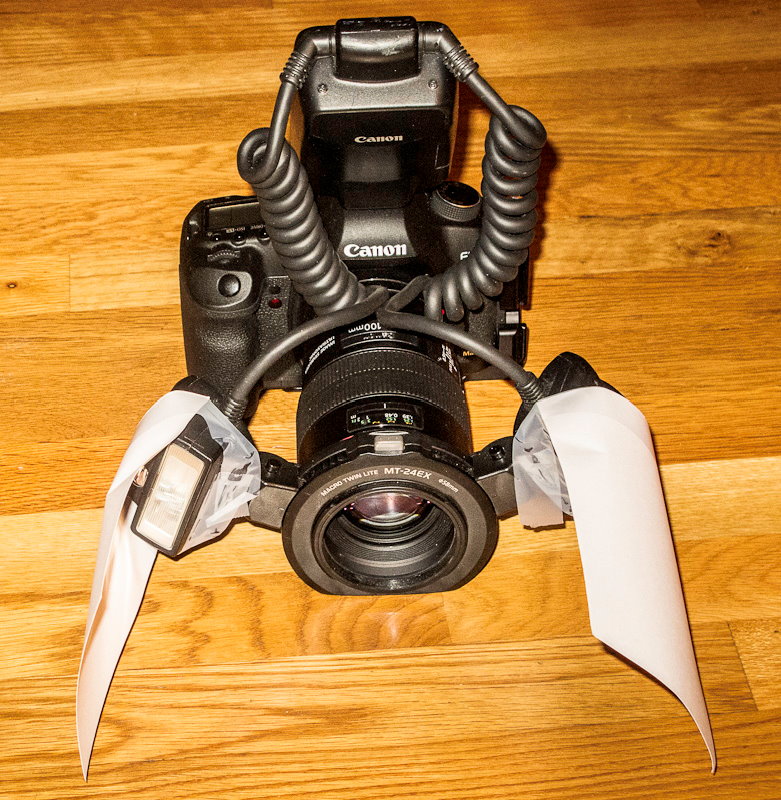
The most important parts of the equipment setup are the two index cards taped to the flash heads. Remember how Simon used open shade to get a nice, soft light on the snake. I’m using the index cards similarly, to soften the light. The flash heads point away from the snake, and the actual light for the photograph will come from reflection of the flash from the cards. This makes for a larger, softer light than if the flashes were aimed straight at the snake. The second important piece is the macro lens. This lens will go up to a magnification of 1:1. The snake won’t need that much magnification, but it needs much more than more common lenses would provide.
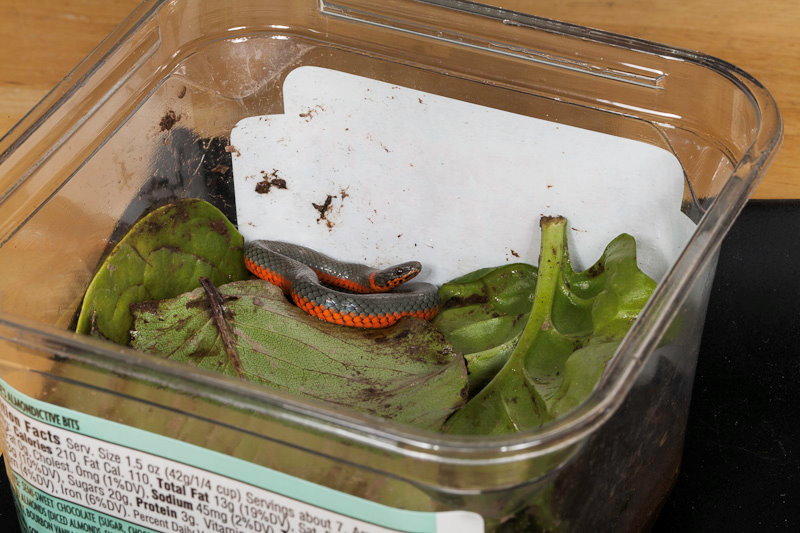
Here’s an overview of the snake in its container. This is simply a record shot. It shows the subject but is not particularly interesting beyond that. For a more interesting view, let’s get closer.
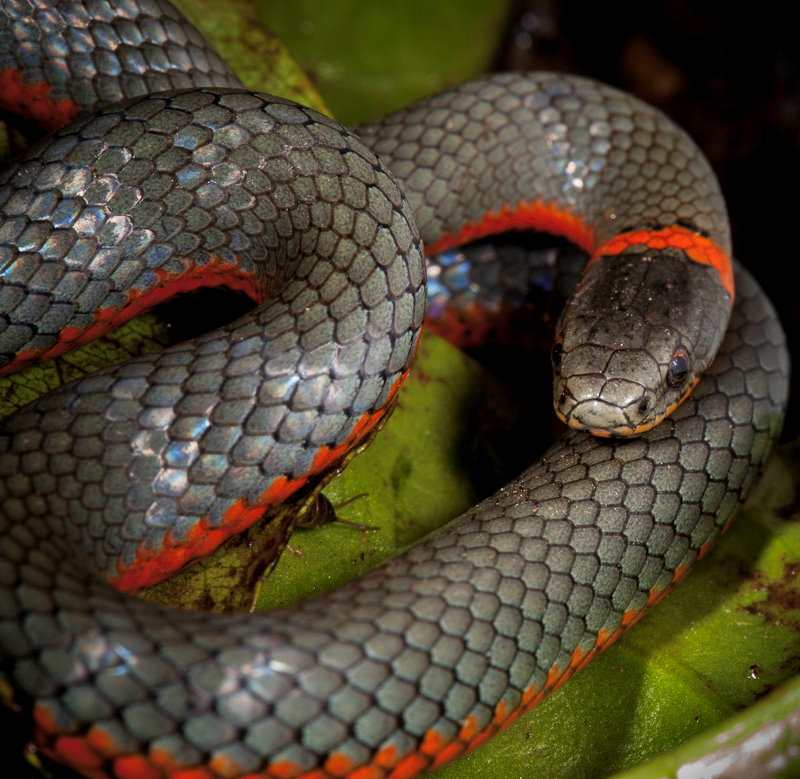
Moving closer allows us to eliminate the uninteresting container, and to see the snake face to face. Much better. The background looks like it could be outdoors, the snake’s eyes are in good focus, and the green leaf complements the snake’s beautiful orange belly and neck ring. You can see that parts of the snake are not fully in focus. The depth of field is very shallow in macro photography, and even at f/20 there are out-of-focus areas. A smaller aperture (f/32 is as far as this lens will go) would improve depth of field slightly, but there would still be areas of softer focus. Something that isn’t obvious is that this image has been darkened considerably on the right. That’s where the white label of the container was located, just to the right of the edge of the photo, and light bouncing off it mad that entire side of the image too light. I use Lightroom for much of my photo processing. It has a tool called a graduated filter that lets you apply adjustments such as reducing lightness in specific areas of a photograph. I used this tool in several parts of the photo to darken areas around the edge that were originally way too bright.
I wanted to try photographing the snake in a simpler environment. A black ceramic dish seemed like an appropriately simple base. But I knew that putting the snake on a plate and then picking up a camera was a certain plan for losing it. I really didn’t want it to escape into some crevice in the house, or worse yet, be found and killed by my cat. So I bribed my son, Ross, to take on the job of snake wrangler. Ross put the snake on a black ceramic dish, and kept it there, while I got up close with DSLR, macro lens, and macro flash.
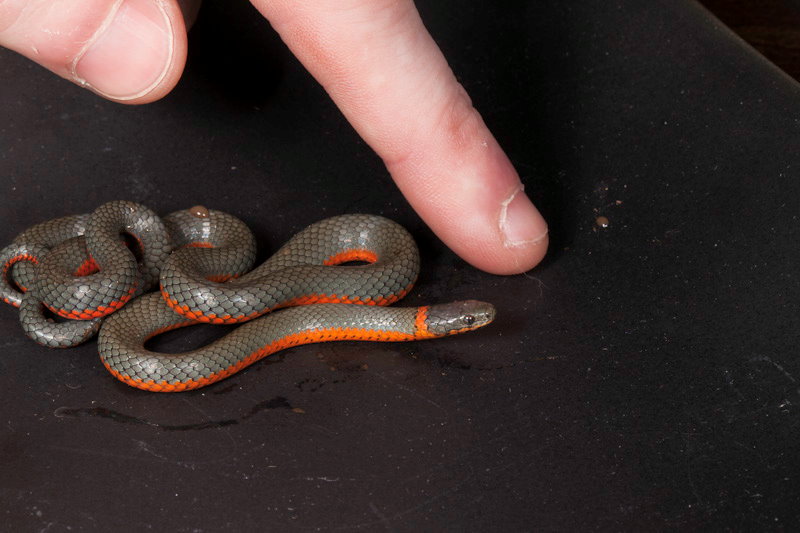
Ross encourages the snake to move away from the edge of the dish.
The snake was cautious and moved slowly when it was first put on the plate. But it soon decided it didn’t like being out in the open, and started to move. We had about two and a half minutes to photograph, before it got so active we had to restore it to its container.
I’m moderately happy with these photos. They show the snake’s shape and color, and the plain background emphasizes the subject. There are flaws, however. The macro lights, coming in from the sides, show every bit of dust and lint on the dish and tabletop. I spent a fair amount of time in Photoshop cleaning up bits of dust on the tabletop. The snake has drops of dirty water here and there, and I think the head could be sharper. I wish I had the flicking tongue that Simon captured. For the next round of photos, I’ll be cleaning the surroundings to get rid of dust, and will experiment with wider apertures. Shooting at f/32 means maximum depth of field, but it also means that diffraction may be softening the image somewhat. Having a wrangler was essential. Ross worked nonstop to keep the snake positioned and to prevent escape. I couldn’t have done all that and worked the camera too. I would have needed two extra arms and a couple of extra eyes.
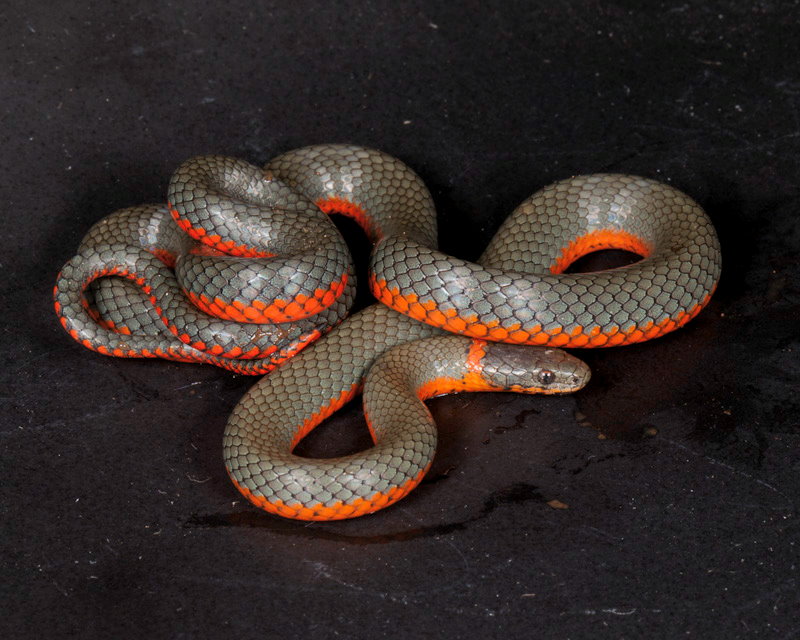
Ring-neck Snake on Ceramic Dish
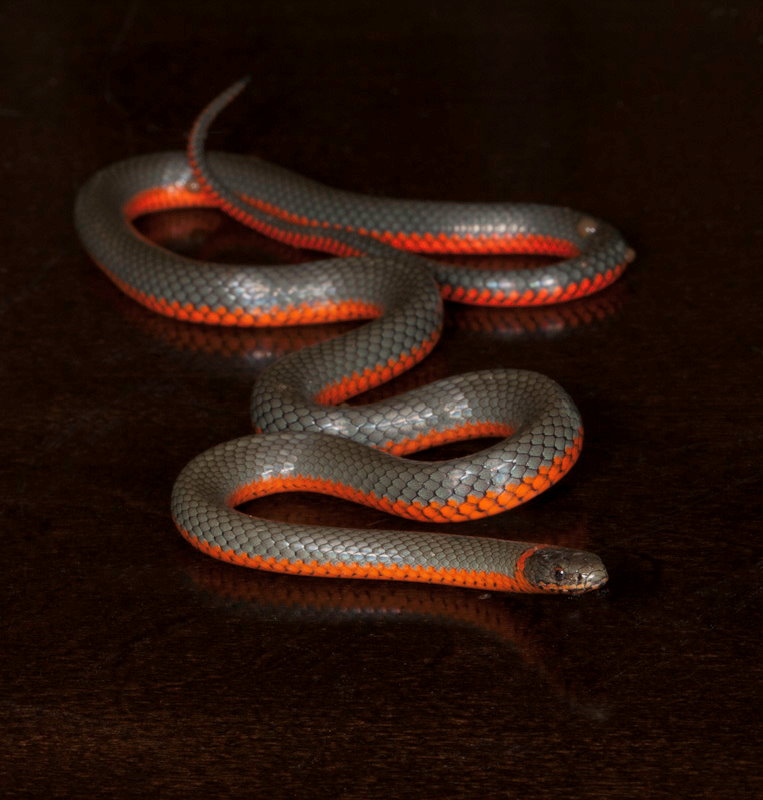
Ring-neck Snake on Wood Table