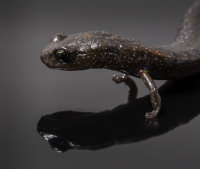
Newt Eggs and Hatchling
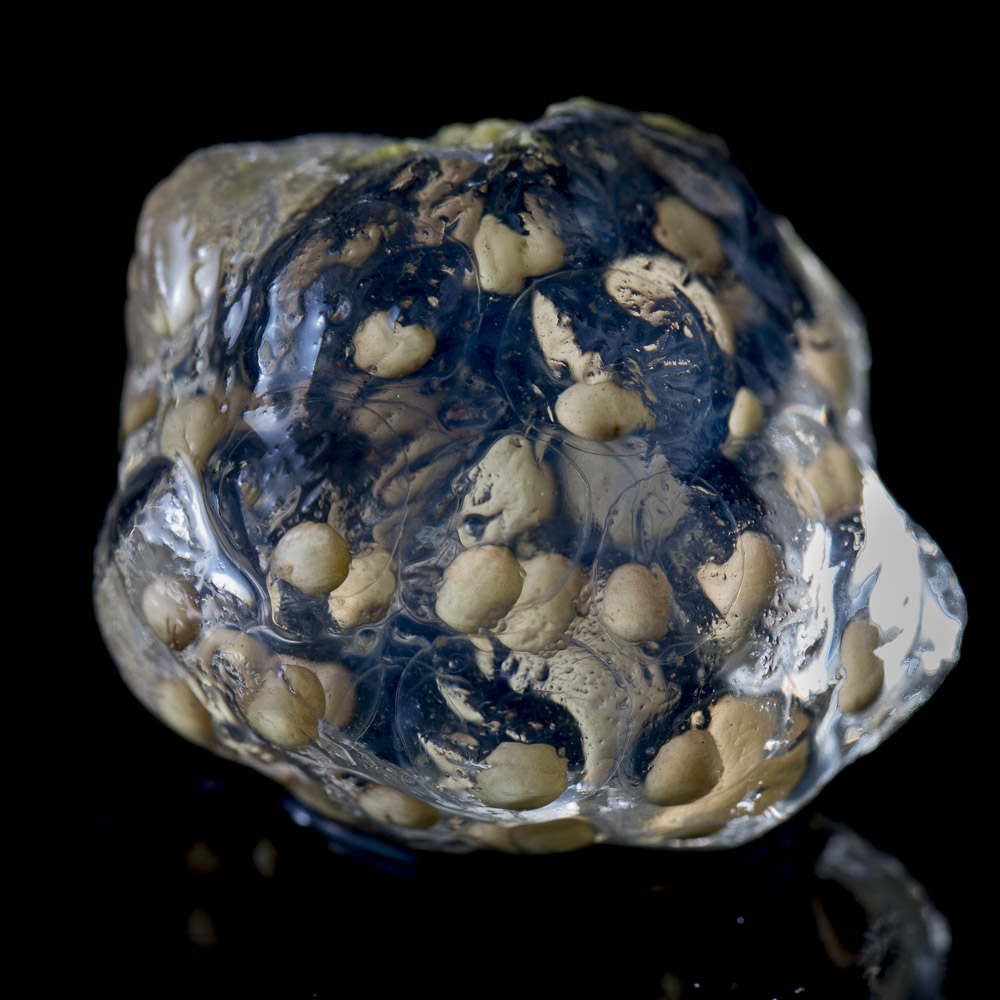
The fishpond at Patrizia's house was full of California newts, reproducing like crazy. She collected an egg mass, and placed it in an aquarium for observation. Newts embed multiple eggs in a mass of what looks like clear Jello. This egg mass is a little smaller than a golf ball. If you look closely, you can see that there are boundaries within the mass, indicating that each egg is encased in its own glob of gel, and then they're all stuck together.
The pond water in the aquarium was not very clear, so to photograph the egg mass, we scooped it out of the aquarium and placed it on a black surface, restoring it to the aquarium once photography was finished.
Photographing a transparent object is a lighting challenge. I didn't want a lot of clutter, so I taped together some black foam-core board to use as a background. Positioning flash units around the front and sides gave ugly results. There were way too many reflections, the glare from the surface obscured the eggs, and the whole surface looked as though it had a film over it. Since neither front nor side lighting was working, SImon suggested backlighting. I placed a single flash behind and to one side of the egg mass. Then I added another bit of foamcore to block direct light from the flash from hitting the lens. That worked! The transparent egg mass let light come through, and because of internal reflections, even the fronts of the eggs were illuminated.
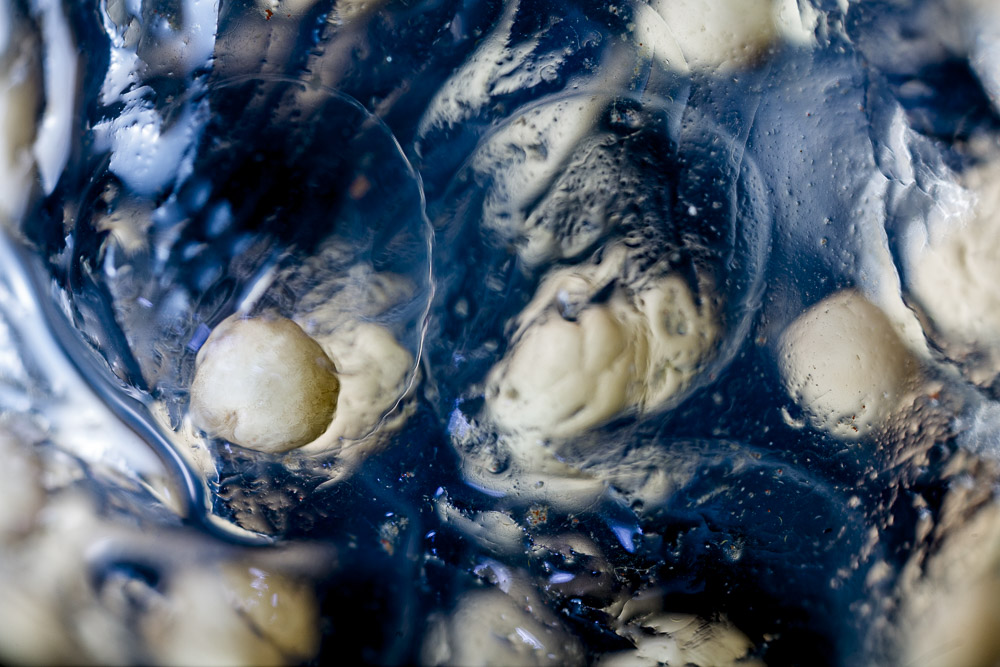
About three weeks later, there had been considerable progress. Baby newts (efts) were clearly visible within the egg mass. We could see eyes and feathery external gills. Every so often a newt will give a wriggle, and flip to a new position, much like an unborn baby kicking within its mother's womb.
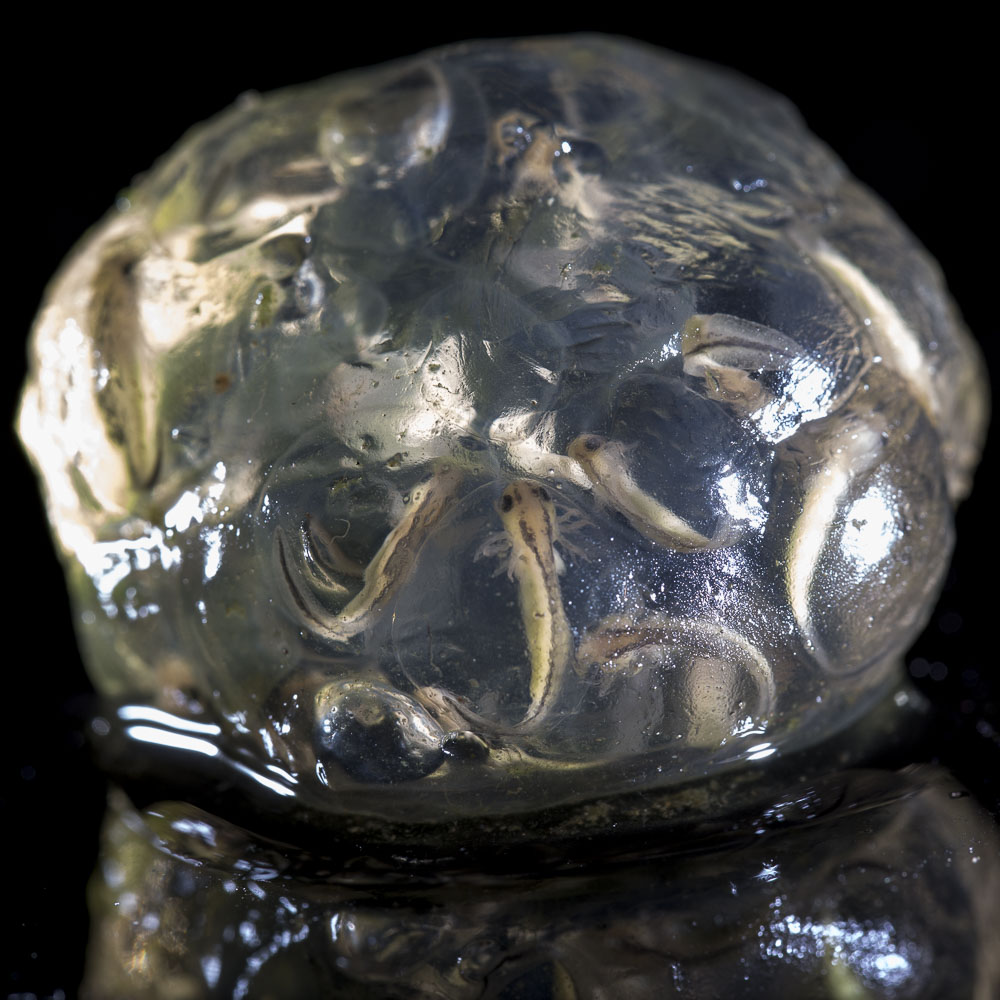
Then the newts began to hatch. Photography was a new challenge. We couldn't photograph the newts within the aquarium because the sides weren't smooth enough for good imaging, and the water was filled with particles of organic matter. But we couldn't just take one out and phtoograph it in air. The hatchlings are entirely aquatic, and needed to stay wet. Simon came up with an ingenious solution. He happened to have some cuvettes. These are small containers used in measuring the light transmission/absorption properties of various liquids in an instrument called a spectrophotometer. Cuvettes have a pair of clear, flat sides, for transmitting light, and a pair of ridged sides that offer a good gripping surface. You hold the cuvette by the ridged sides to leave the clear ones free of fingerprints. Simon's cuvettes were just the right size for holding a newt hatchling. Patrizia carefully scooped one out of its aquarium and placed in a cuvette, along with a bit of aquarium water, to pose for its photograph.
We set the cuvette on top of an old film can (remember film?) in the same setup we'd previously used for the egg mass, and lit it from behind as before. Although the aquarium water wasn't completely clear, it didn't obstruct the view of the newt.
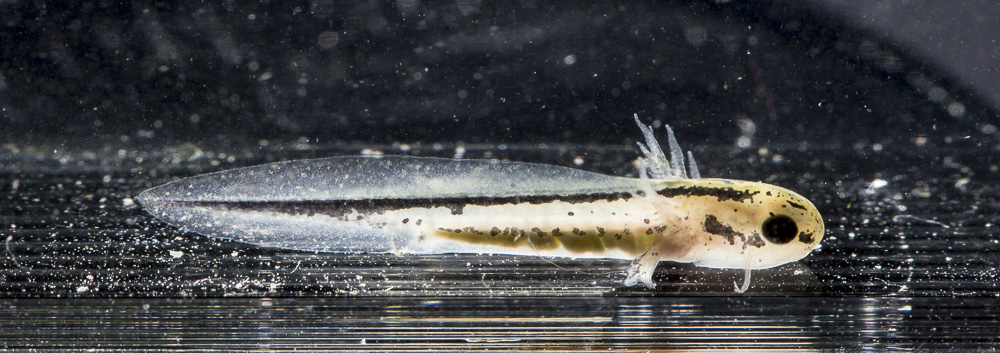
Here's the setup used to photograph the hatchling in its cuvette. It's essentially the same one used for the egg mass as well.
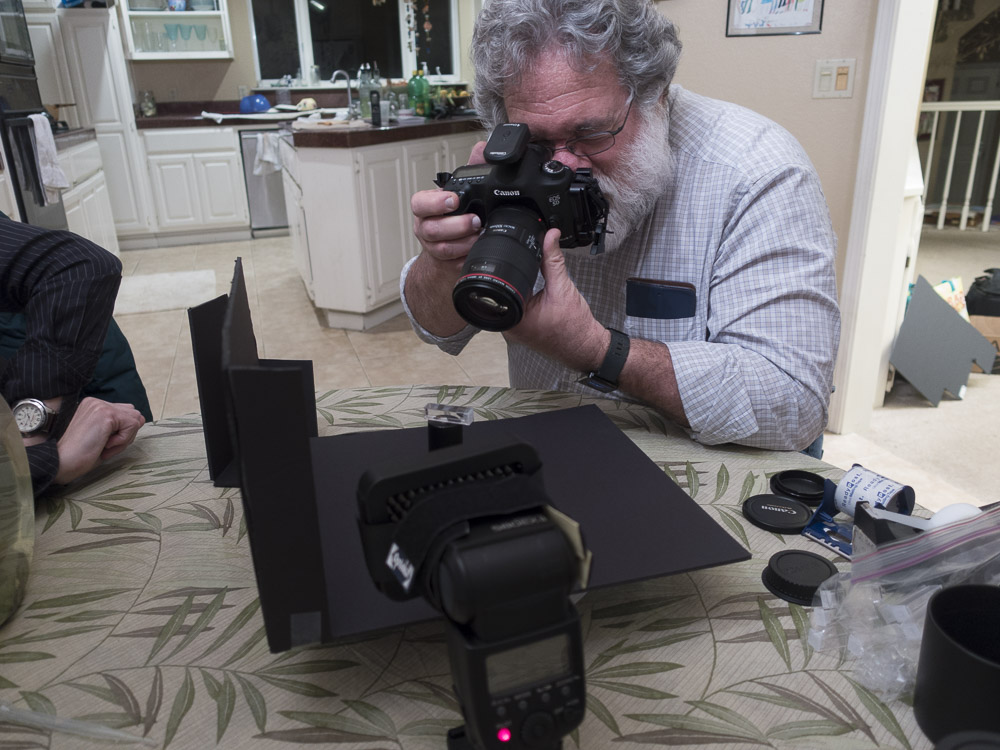
I used a Canon 5D mk iii, with a Canon 100mm f/2.8 macro lens. You can see how the flash is illuminating the cuvette from the rear. I've put a small inexpensive grid unit on the front of the flash. Grids narrow the flash beam, and I wanted to keep direct flash from striking the camera lens. The flash is being triggered wirelessly using a Cowboy Studio transmitter in the camera hotshoe and the corresponding receiver attached to the flash. These cheap triggers don't provide the full auto-flash capabilities of more expensive units, but when you're using manual settings for flash, it doesn't really matter. I set camera exposure and flash power manually, using the camera's histogram to home in on a correct exposure. With this much black in the scene, automatic flash control is likely to yield excessive exposure. Notice that my elbow is braced on the table for support.
The newts are out in nature now. At age three, they'll begin making baby newts of their own.