Spider Hatchlings
The subject line of Simon’s email read, “We have dozens of baby black widow spiders!” I’d been expecting this. Weeks before, Simon’s neighbor, John, had found a very large black widow, captured it, and given it to Simon in a jar. Soon we found out why she was so big. A large silk egg case appeared in the jar, and the spider herself was much slimmer. Now the eggs had hatched.
I grabbed my camera and drove over to Simon’s house. He had sealed the jar into a large plastic bag to prevent spider escapes in the house, but we’d need to open the bag and the jar to get clear photographs. We went out to the yard where there’s a small flatbed trailer, and set up on the trailer bed, maybe a foot or so above ground level. We had the naive idea that we could keep the spiders contained by placing the jar in the middle of a pan of water. That turned out to be totally wrong, as we soon learned.
When we opened the jar, we saw dozens of spiderlings sitting on newly-spun webbing, with the mother spider keeping watch over the egg mass. The hatchlings were very small – perhaps 1/8 inch across from leg-tip to leg-tip. So I would need as much magnification as I could get. That meant pulling out the Canon MP-E 65mm macro lens, a specialized manual-focus-only optic that provides magnifications from 1x to 5x. With the spiders, I’d be using it mostly at 4x or 5x magnification. I also used a Canon 100mm f/2.8 macro lens for shots with more context but less magnification.
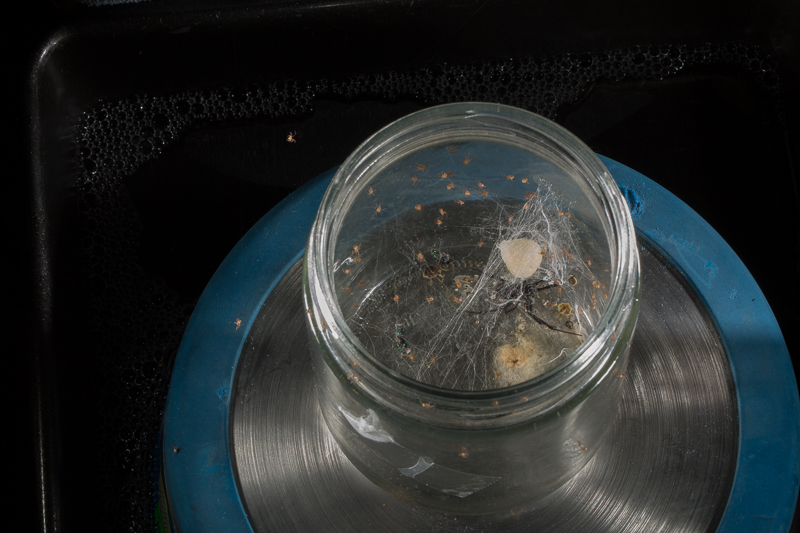
Jar with baby spiders, egg mass, and mother spider. Canon 5D Mark III, Canon 100mm f/2.8 L Macro lens, 1/160 sec, f/32, ISO 200.
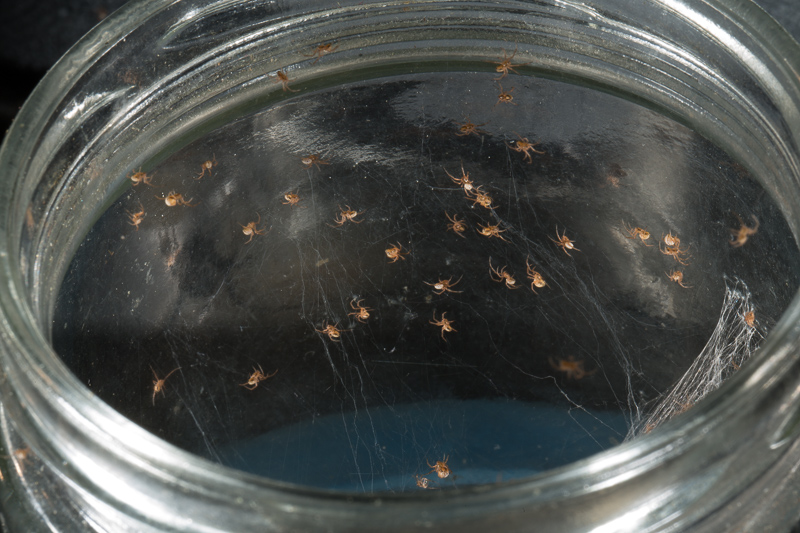
Newly hatched spiders on sebbing they've spun across the top of the jar. Canon 5D Mark III, Canon 100mm f/2.8 L Macro, 1/160 sec, f/32, ISO 400.
The Canon MP-E 65mm macro lens is a wonderful tool, but using it demands careful technique. The lens has no autofocus. You simply set the desired magnification, and move the camera/lens combination back and forth to focus. It also can yield very dim viewfinder images. With the lens extended to 5x magnification, the effective f/stop is multiplied by six (numerically one more than the magnification), so even wide open, an f/2.8 lens becomes an f/17 lens, and the viewfinder is correspondingly dim. We were working outdoors in the evening, so we needed as much light as possible to even be able to see the spiderlings in the viewfinder. Simon had a large floodlight that we positioned to the left of the spiders. This gave a good strong light for focusing. However, it wasn't enough to photograph with. The spiders were very active, so I wanted to hand-hold the camera to allow for rapid adjustments in framing and focus. That meant that I'd need flash, both for additional light and to eliminate the blur that would result from camera shake and spider motion. The short duration of electronic flash effectively freezes motion. We positioned three electronic flashes around the setup. Each flash was mounted on a radio remote trigger, with the transmitter in the camera's hotshoe. We could have used hard-wired camera-to-flash connections, but doing that would have meant multiple cords draped across the setup, getting in the way.
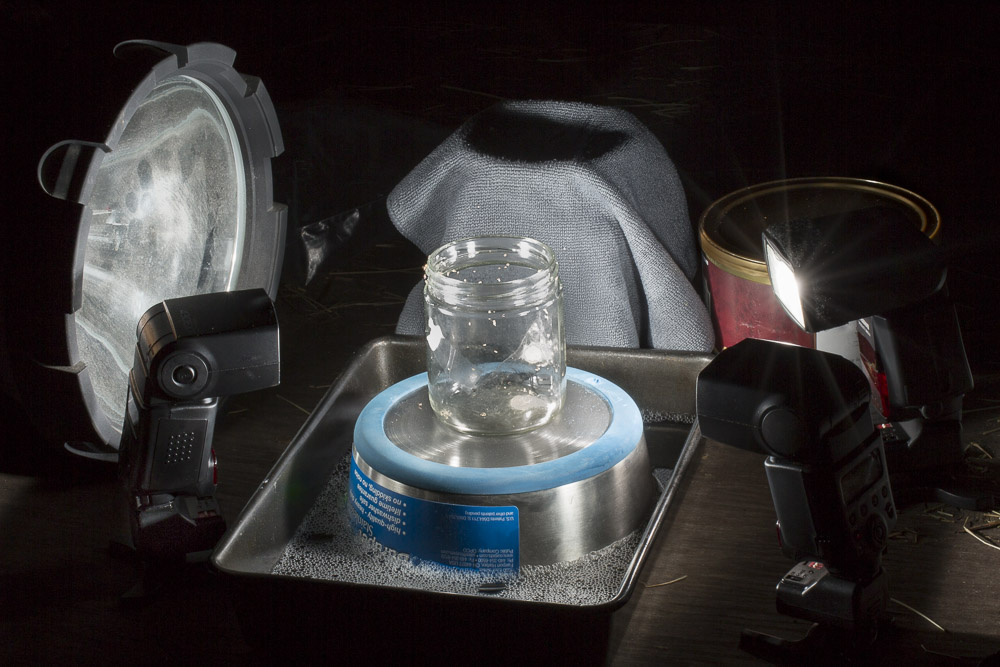
Setup for photographing the spiders. Canon 5D Mark III, Canon 100mm f/2.8 L Macro, 1/160 sec, f/32, ISO 400.
We opened the jar. There were dozens of baby spiders sitting on silk strands near the opening. At first they did not move. Then the bolder ones started to explore. What we’d see over the next 45 minutes or so was an education in spider versatility. We had hoped to prevent the spiders that escaped the jar from going astray by putting the jar on a support in the midst of a tray of soapy water. Our theory was that the spiders would crawl down to the water, dislike the soap, and stop. That's not even close to what happened. The moat of soapy water was no barrier at all. The spiders spun out fine strands of silk, which enabled them to float across to the edge of the tray. Even though there was almost no wind at all, there was just enough to carry the silk across to the edge of the tray, to the flash units, and even farther. The spiders then had bridges along which to walk, and could use them to travel even farther, or as the base for a web. We saw both behaviors. In addition, some of the spiders simply spun a long thread, and as it caught the breeze, it would lift them and carry them through the air. So many of them did this that at one point, it seemed as though the entire area for a radius of maybe 6 feet around the jar was full of tiny spiders. Some of them even landed on my arms. But either they did not want to bite or their fangs were too short to penetrate my skin. In any case, I had no spider bites. I might not have been so lucky with the mother spider. While so many spiderlings were escaping, a number of them stayed put in the jar. I don't know what made some leave and some stay.
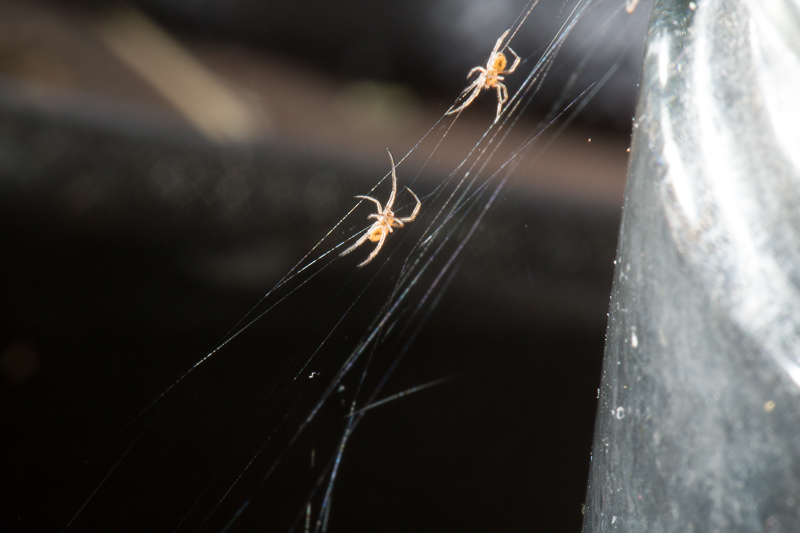
Baby spiders on newly spun silk strands. Canon 5D Mark III, Canon 100mm f/2.8 L Macro, 1/160 sec, f/32, ISO 800.
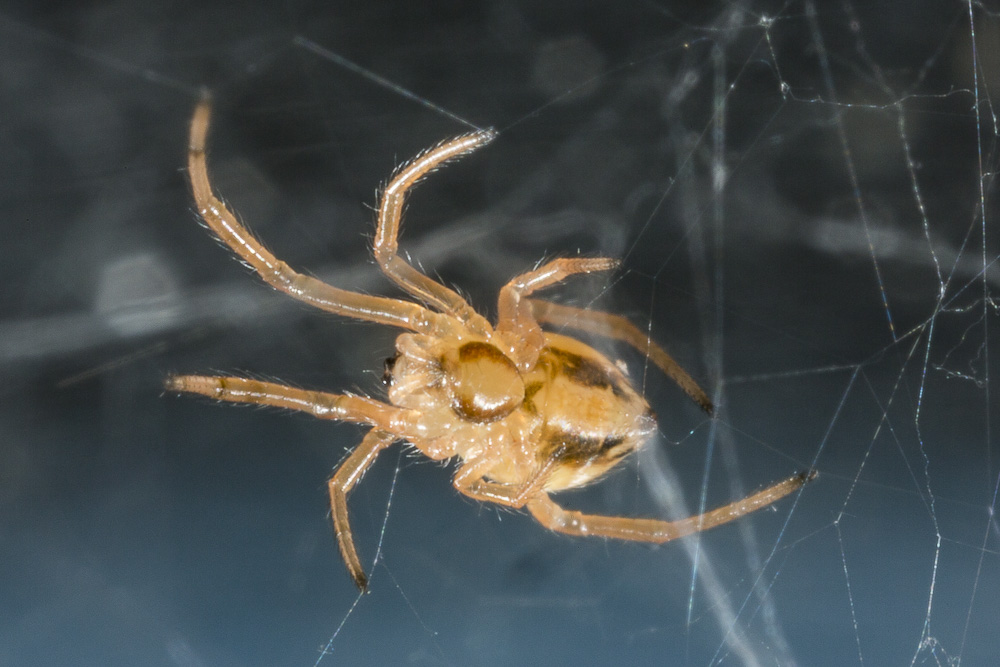
Baby spider on newly spun silk strands. Canon 5D Mark III, Canon MP-E65mm f/2.8 lens, 1/200 sec, f/16, ISO 800. Magnification setting approximately 4X, but not recorded.
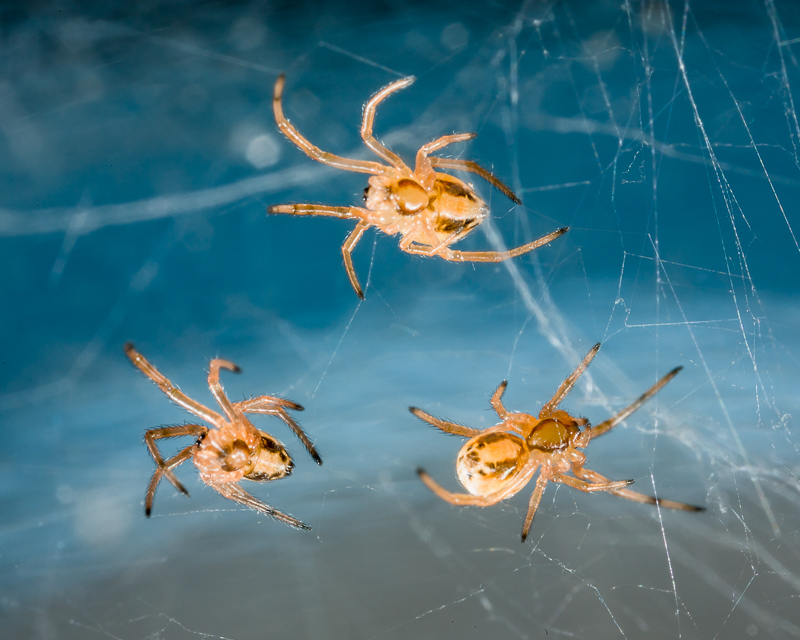
Three newly hatched spiders in web. Canon 5D Mark III, Canon MP-E65mm f/2.8 Macro, 1/200 sec, f/16, ISO 800.
One of the reasons I like photographing invertebrates is that there's so much to learn. Much of it is likely old news to entomologists and arachnidologists, but seeing it for myself is exciting and interesting. The evening I spent with these spider hatchlings was a memorable time, both for the images and for the experience of seeing the resourceful way they were able to disperse into the world.