Centipede and Cottage Cheese
Standard macro techniques often come up short when the subject is alive. To photograph a coin, you have all the advantages of a stationary subject, the ability to mount the camera rigidly on a tripod or stand while you focus carefully, and you can fine-tune lighting to your heart’s content. With a live, moving subject, you have to be more flexible.
This centipede was in near-constant motion, and very quick. I needed to confine it enough so that it wouldn’t escape, but I didn’t want to clamp it or restrain it in some other way that might cause injury. I also wanted to light it cleanly, without a lot of shadows.The solution was to put it into an empty cottage cheese container. I thought I’d be spending a lot of time keeping it from climbing the container wall, but it didn’t seem able to get traction on the smooth plastic. It reared up periodically, but couldn’t manage to escape.
I aimed two flashes at the outside walls of the container, one on each side. These produced enough light to penetrate the white plastic walls of the container, and their short light pulses were great at stopping the centipede’s motion. The flashes happened to be mounted in softboxes, because I was using them for other subjects in the same session, but the softboxes weren't really needed. The container provided plenty of diffusion, and the interior reflected it all around, for a soft, nearly shadowless light.
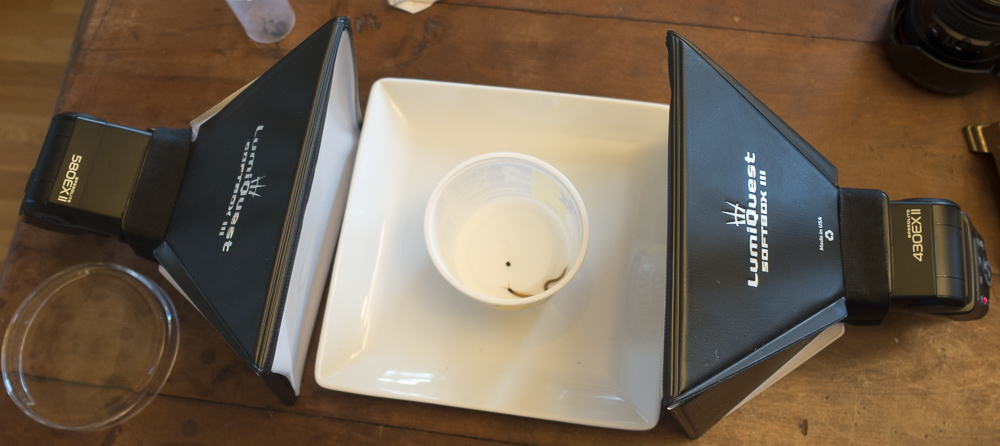
In this sort of setup, manual flash control is best. I usually prefer to figure out my exposure using an inanimate substitute subject before putting the real critter into the picture. Anything that’s medium-toned and not too large will do as a surrogate for measuring exposure, even a wad of colored paper. I set the camera for manual exposure, with a medium aperture and shutter speed at or below the sync speed. Then I shoot the substitute subject and check the histogram. It should have bars almost all the way to the right, but not piled up against the right edge.
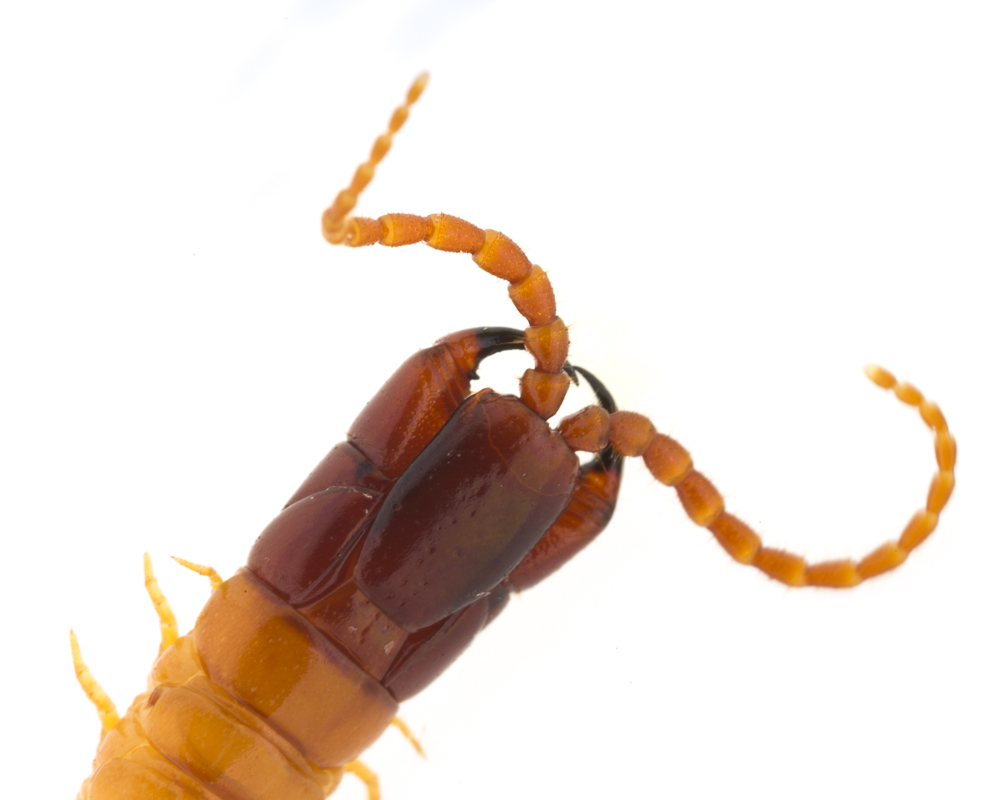
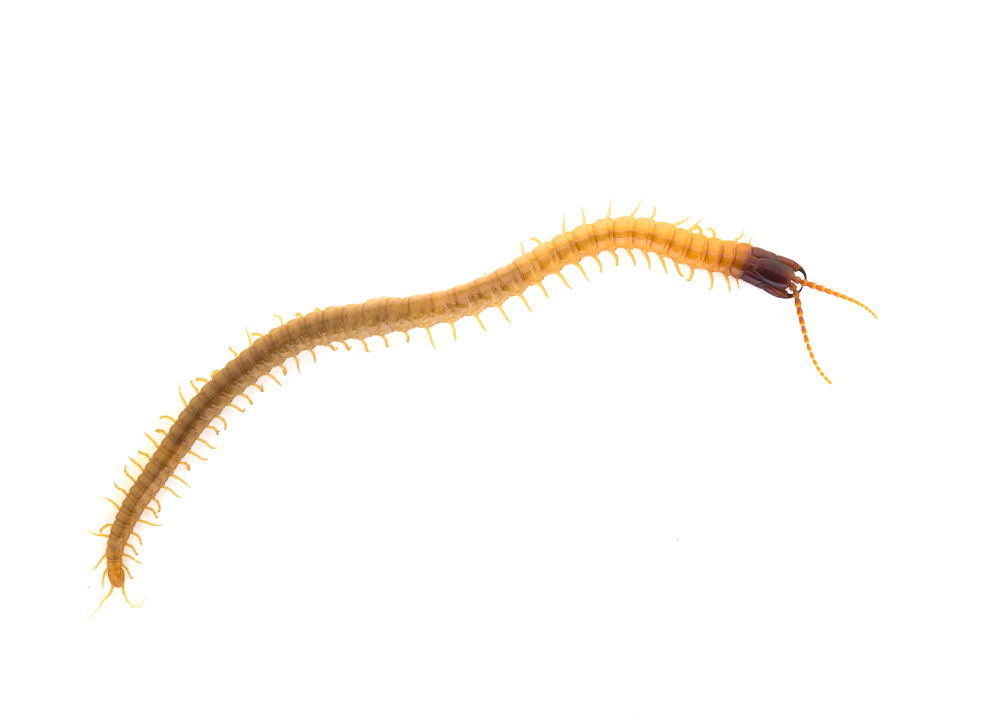
With exposure dialed in, the main problem was to keep the centipede in the viewfinder and in focus long enough to release the shutter. I had a lot of near misses, and a lot of shots that weren’t even close. But with a critter in more or less random motion, that’s to be expected. The thing to do is to just keep on shooting, trying your best on each shot. Almost every critter will stop occasionally, even if only for an instant, and those instants are the best opportunities for a sharp photo. With patience and a lot of wasted frames, I wound up with a few keepers.
Centipedes and millipedes look a little alike. Both are long, many legged creatures. But they're actually quite different. Millipedes like to feed on decaying organic matter, and have no venom. Centipedes are hunters, using the large venom-bearing fangs you can see in the photo above. For the most part, a centipede bite is not fatal to humans, but it is painful, and can cause swelling and other symptoms. I strongly recommend using forceps or other tools when you need to handle one.
If you look closely at the setup, you'll notice that the printing on the cottage cheese tub is visible. When Simon saw this, he suggested removing the ink with acetone. It turned out to work beautifully. If you do try this, use the acetone in a well-ventilated place, avoid breathing the vapors, and stay far away from any flames.